
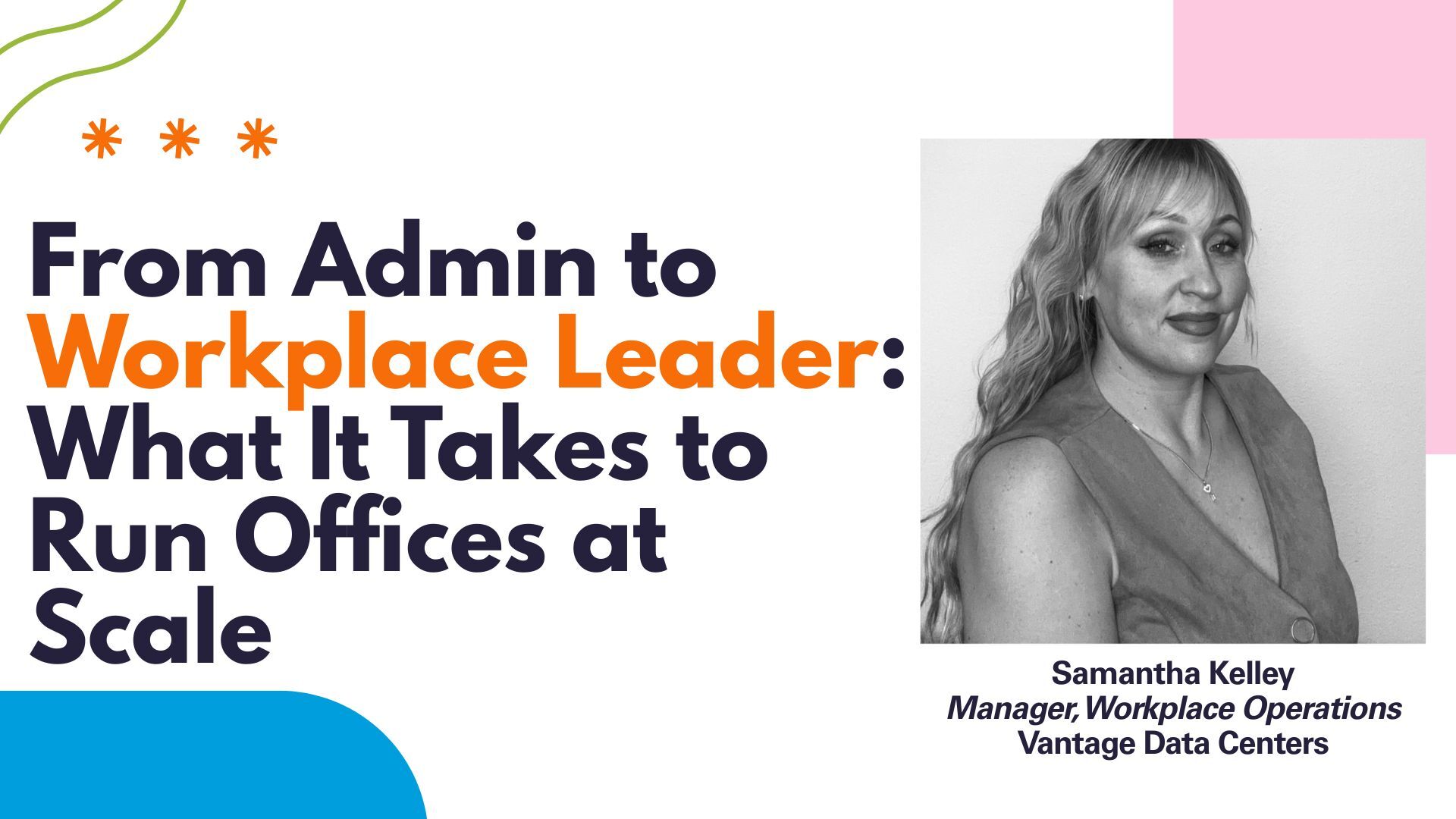
15 May From Admin to Workplace Leader: What It Takes to Run Offices at Scale
Samantha Kelley on career growth, leadership, and the reality of workplace operations
Workplace operations roles are often invisible when everything is running smoothly.
But behind every well-run office is someone managing hundreds of small decisions every day: floor plans, vendors, employee requests, events, seating assignments, office standards, and more.
Samantha Kelley oversees workplace operations across five office locations for Vantage Data Centers and serves as the business partner to executive assistants across North America.
Her role touches nearly every aspect of the workplace experience.
And like many workplace leaders, she didn’t start out planning this career path.
Building a Career Through Administrative Roles
Sam began her career in accounting before moving into office management and administrative roles within the oil and gas industry.
Over time, she worked through nearly every level of administrative support.
“I worked my way through all of the administrative roles.”
— Samantha Kelley
Those roles included:
- Office assistant
- Administrative levels
- Senior administrative assistant
- Executive assistant
Each step added a new layer of understanding about how offices operate and what employees need to do their jobs effectively.
Eventually, that experience evolved into her current role overseeing workplace operations across North America.
“It kind of took everything I’d done in my career and rolled it up into one role.”
— Samantha Kelley
The Mindset That Drives Workplace Leaders
While experience helped prepare Sam for the role, she credits her success to a particular mindset: never being above the work.
“I never feel above a task.”
— Samantha Kelley
Even as a senior workplace leader, she’s willing to jump in wherever needed.
“No task too big, no task beneath me.”
— Samantha Kelley
For workplace professionals early in their careers, that mindset can open doors.
Understanding the details of office operations—from moves to scheduling to support work—builds the foundation for leadership later on.
A Role That Touches Everything
Sam’s responsibilities are broad.
She oversees workplace operations across multiple states, manages office managers who report into her, and partners with executive assistants supporting leadership teams.
Her day-to-day work might include:
- Hiring and onboarding office managers
- Managing vendor relationships
- Reviewing office layouts and floor plans
- Coordinating construction or office expansions
- Supporting executive assistants
- Traveling between office locations
“It’s a very broad role. So day to day, it’s very all over the place.”
— Samantha Kelley
In many ways, workplace operations acts as the connective tissue of an organization.
The Most Important Workplace Ops Skills
When asked what skills make someone successful in workplace operations, Sam highlighted three in particular.
Multitasking
With multiple offices and constant change, workplace leaders must juggle competing priorities.
Approachability
Employees need to feel comfortable bringing concerns forward.
“Being out in front of people… letting them know this is how I can make life easier for you.”
— Samantha Kelley
Boundaries
Without boundaries, workplace leaders can quickly become the catch-all for every request.
“If you give an inch, they’ll take a mile.”
— Samantha Kelley
Learning when to redirect requests is essential.
“You have to be able to delegate.”
— Samantha Kelley
The Hidden Role of Workplace Ops: Supporting the Support Staff
In Sam’s structure, office managers report into her, and she serves as a resource when they encounter challenges.
Sometimes that means helping resolve conflicts or navigating pushback from other teams.
“Loop me in… sometimes you gotta strong arm people.”
— Samantha Kelley
She jokingly describes the role as:
“The protector of all the office support.”
— Samantha Kelley
But the impact is real. Office managers often operate on the front lines of workplace experience, and strong leadership support helps them succeed.
Creating Consistency Across Offices
One of Sam’s biggest priorities has been creating a consistent employee experience across locations.
Before her role existed, office standards varied depending on the office manager or department overseeing the space.
“There was really no framework for that until I stepped into this role.”
— Samantha Kelley
Now the goal is clear: ensure employees receive the same level of support regardless of where they work.
“We want our employees to know they’re taken care of regardless of where they sit.”
— Samantha Kelley
The Most Unexpected Workplace Challenge
Despite the complexity of vendor management, events, and office expansions, Sam says the most persistent challenge is something surprisingly simple: seating.
Employees care deeply about where they sit—window access, lighting, proximity to teammates, noise levels.
“You would be surprised how many obstacles are in the way of who sits where.”
— Samantha Kelley
Even after carefully planned moves, employees sometimes rearrange themselves.
“The next day people decide to play musical chairs… then your floor plans are off and your nameplates are off.”
— Samantha Kelley
Her comparison captures the chaos perfectly.
“It’s like putting kindergartners on a bus and assigning them seats.”
— Samantha Kelley
The Shift Toward Employee Experience
Over the past few years, Sam has seen a major change in how companies view workplace operations.
Leadership teams are increasingly prioritizing employee engagement and experience.
“There’s been a huge shift in employee engagement and employee experience.”
— Samantha Kelley
That shift has allowed workplace leaders to focus more intentionally on the environment employees experience every day.
Planning Engagement Like a Program
At Vantage, workplace operations now plans events strategically rather than reacting throughout the year.
They’ve developed a full calendar of events so employees know what’s coming.
“Let’s work on a calendar of events for the entire year.”
— Samantha Kelley
Events range from summer picnics and sporting outings to office cook-offs and game days.
Many events occur during work hours to encourage participation.
The goal is simple: create opportunities for connection that break down silos between teams.
A Role That Didn’t Exist—Until It Did
Sam’s position was created only recently, but its impact has already been clear.
Looking back, she sometimes wonders how workplace operations functioned without it.
“It’s kind of one of those things where it’s like… how did we ever survive without someone in this role?”
— Samantha Kelley
For companies growing quickly, dedicated workplace leadership can bring clarity, consistency, and structure to the employee experience.
A Simple Mission
At the end of the day, Sam’s mission as a workplace leader is straightforward.
Create offices where employees feel supported, connected, and equipped to do their best work.
Sometimes that means managing vendors or planning events.
Other times it means navigating floor plans or helping office managers solve problems.
And occasionally, it means staying late to finish nameplates for an office move.
Because in workplace operations, every detail contributes to the experience employees feel every day.