
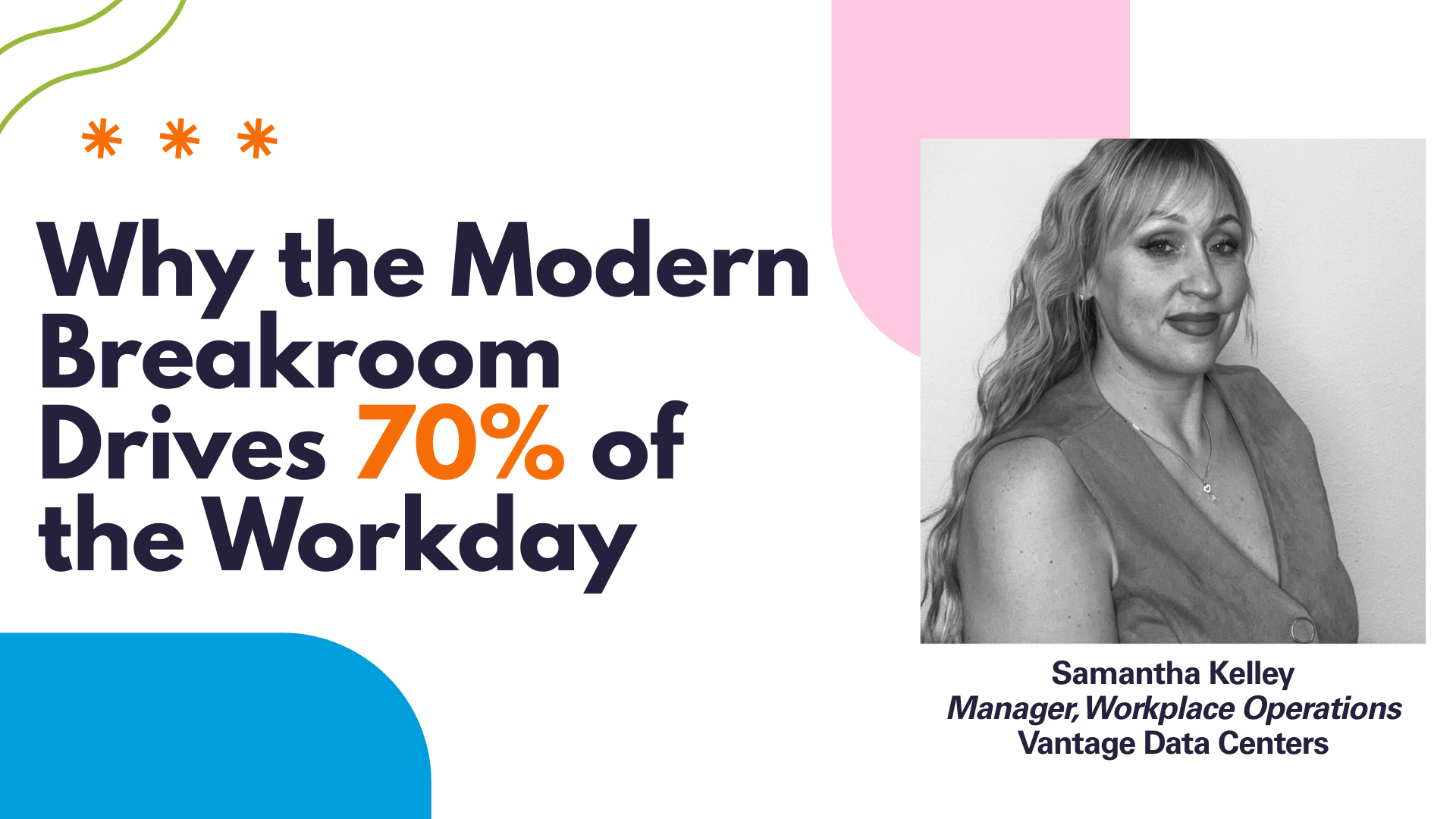
20 Mar Why the Modern Breakroom Drives 70% of the Workday
Inside Vantage Data Centers’ approach to snacks, vendor partnerships, and workplace experience
For many workplace leaders, the breakroom used to be a simple operational detail: a fridge, a coffee machine, maybe a few snacks.
Today, it’s something very different.
At Vantage Data Centers, workplace operations leader Samantha Kelley sees the breakroom as one of the biggest drivers of employee experience—and productivity.
When asked how much impact the breakroom has on employee satisfaction, she didn’t hesitate.
“I’d say 70. People love their food around here.”
— Samantha Kelley
But this isn’t about perks. It’s about removing friction from the workday and creating spaces where employees can recharge, connect, and stay productive.
Here’s how Sam approaches breakrooms, pantry programs, and vendor partnerships—and what workplace leaders can learn from it.
The Breakroom Is No Longer a Perk
For Sam, the biggest shift in workplace design is recognizing that employees need more than a desk and a laptop to do their best work.
The breakroom has become an essential operational hub.
Employees work hard. Many commute. Some skip breakfast or lunch. And not everyone has time to leave the office during the day.
Providing accessible food and beverages helps eliminate those interruptions.
“You get the most productivity from everyone when you have the basic essentials.”
— Samantha Kelley
Those essentials might include:
- Protein shakes and energy drinks
- Nuts and granola
- Hummus, boiled eggs, and fresh items
- Coffee and beverage programs
- Snacks that support energy throughout the day
In Sam’s view, the modern workplace should allow employees to arrive, focus, and get through the day without unnecessary disruption.
“You just show up. Do you have a headache? Go to the medicine cabinet. Need a snack? It’s right there.”
— Samantha Kelley
Food Programs That Bring Employees Together
At Vantage, food programs extend beyond the pantry.
The company also runs office lunch programs, catering meals on core office days depending on location.
For example, the Denver office hosts catered lunches on Mondays and Fridays. Other offices adjust the schedule depending on when employees are most likely to be on-site.
Food consistently drives participation and engagement.
“Food is a huge driver… because we had lunch brought in or because they can go pick through a million energy drinks to get through the workday.”
— Samantha Kelley
While many workplace leaders try to diversify engagement events, Sam admits food often becomes the center of workplace programming.
Because it works.
Breakroom Design Matters Too
Food may draw people in, but design determines whether a breakroom becomes a real gathering space.
For Sam, the goal is simple: create a welcoming place where employees can step away from their desks and interact.
“We want a welcoming place where everyone can come together… have a snack and chat.”
— Samantha Kelley
In larger offices, flow becomes especially important.
If your workplace regularly hosts catered lunches or events, the space must handle large groups efficiently.
“Are you equipped for that? Do you have the space to let employees go sit away from their desk and actually enjoy their break?”
— Samantha Kelley
The Denver office already has a strong breakroom setup, and a California office remodel is currently planned to improve collaboration and shared space.
Why Vantage Chooses Pantry Programs Over Micro-Markets
While many companies are exploring micro-markets, Sam says Vantage primarily relies on office pantry programs.
“It’s always an office pantry. We provide everything.”
— Samantha Kelley
Because the pantry program already provides a wide variety of food and beverages—and because many employees work hybrid schedules—she hasn’t seen a strong need for additional retail-style options.
“Our pantry services alone are so broad… I’ve just never really found a need to have anything in addition to that.”
— Samantha Kelley
Vendor Selection: Personality Matters
Selecting the right refreshment provider isn’t just about products.
For Sam, vendor relationships begin with personality and partnership.
“If you show up super salesy and aggressive and arrogant… I pretty much write you off.”
— Samantha Kelley
She prefers vendors who are collaborative, responsive, and focused on long-term relationships rather than quick wins.
Why Local Vendors Often Win
Another major priority for Sam is supporting local vendors whenever possible.
“Those local partnerships are huge… it makes each office location more unique.”
— Samantha Kelley
Working with local providers also strengthens relationships within the surrounding community.
“We’re giving back to those small businesses in the communities where we work.”
— Samantha Kelley
For smaller vendors, corporate partnerships can be transformative.
And Sam believes those partnerships often lead to better service.
How to Grow Vendor Partnerships the Right Way
Instead of onboarding vendors across every office immediately, Sam uses a gradual scaling model.
It typically looks like this:
- Start with one location or campus
- Introduce pantry items first
- Evaluate service and reliability
- Expand the partnership to additional buildings or services
“We start pretty small… and then we grow that out as they prove themselves.”
— Samantha Kelley
This allows vendors to build familiarity with the workplace while giving workplace teams confidence before expanding service.
The Breakroom of the Future
Many companies still offer very limited amenities—sometimes little more than beverages.
But Sam believes workplaces are evolving.
“You can truly come here, work all day long, and not leave—and you’re fine.”
— Samantha Kelley
For companies competing for talent and engagement, that level of support can be a meaningful differentiator.
The breakroom of the future will likely combine:
- Expanded pantry programs
- health-conscious options
- spaces designed for connection
- strong vendor partnerships
- consistent employee experience across locations
And for Sam, the formula is straightforward.
Take care of employees’ basic needs, and they’ll bring their best work to the office.